
Long tagged as one of the nation’s deadliest places to walk, the Orlando area is now turning the corner, according to a new study of the 101 largest metropolitan areas released Wednesday.
Read more Christina Grimmie shooting death in Orlando happened 10 years ago
The region, spanning communities from Sanford to Kissimmee, has dropped to the 25th most dangerous, and one of only 18 to improve its pedestrian fatality rate in recent years, according to Smart Growth America’s Dangerous by Design report. Only two regions had greater reductions in fatality rate than Central Florida.
The report shows the region made a drastic improvement from 2021, when the Smart Growth group called Orlando the most likely place for a pedestrian to be killed. That drop can be attributed to other regions seeing their fatality rates sore, and in Orlando’s slowing in 2024 and reducing in 2026.
“We’re starting to see some real improvement in Orlando,” said Beth Osborne, the president and CEO of Smart Growth America. “They used to top our list repeatedly. It was a matter of leadership, both in terms of political leadership and leadership in their public works and transportation office.”
In recent years, Florida transportation planners have taken aggressive action on problem areas around the region, particularly on the 2% of roads in Orange, Seminole and Osceola Counties where 49% of all traffic fatalities occur.
One high-profile improvement is likely a factor in the region’s progress: Early in 2024, the Florida Department of Transportation completed a massive overhaul of a stretch of South Orange Blossom Trail from Interstate 4 south to Holden Avenue, which was then considered one of the deadliest stretches of road in Florida. From 2018 to 2023, 55 crashes with pedestrians were reported there, resulting in 14 serious injuries and nine deaths.
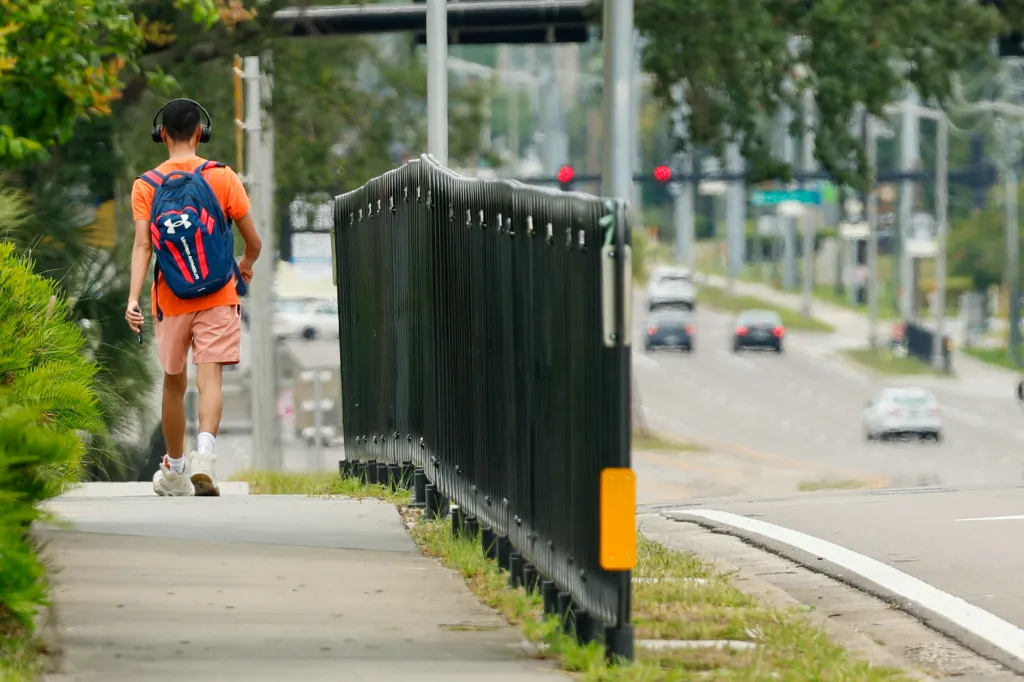
The agency spent $8.7 million to lower the speed limit to 30 mph, added more crosswalks and raised them up to increase visibility, installed flashing overhead beacons and a black fence along the median, channeling walkers to cross only at marked crosswalks. The agency called it its most elaborate pedestrian safety project in its history — and potentially a model to replicate around the state. It’s planning to continue that work on another segment of OBT.
Since then, that stretch has had just one fatality, officials said.
Near the University of Central Florida, similar fencing was installed along sidewalks at Alafaya Trail and University Boulevard by Orange County to help improve a similarly dangerous stretch of road for pedestrians.
“Although encouraging, we still have a long way to go— 65 people were killed while walking in Orlando in 2024,” said Humberto Castillero, Orange County traffic engineering manager, in a statement, citing the new study’s data.
But the region “can take comfort” in knowing that “aggressive and deliberate” work to improve road safety for pedestrians is working, Castillero said. “These investments continue to pay off with lives saved.”
Despite improvements locally, Florida metros remain among the worst nationwide, according to the report, which uses data from the National Highway Traffic Safety Administration and adjusts for varying population sizes.
Six Florida regions are worse off than Orlando: Tampa-St.Petersburg-Clearwater is the 8th most dangerous place for walkers in the country, Palm Bay-Melbourne-Titusville is 11th, Deltona-Daytona Beach-Ormond Beach is 14th, North Port-Bradenton-Sarasota is 15th, Jacksonville is 16th and Miami-Fort Lauderdale-West Palm Beach is 17th.
Read more SpaceX IPO: A glossary to help understand what happens in an initial public offering
The state ranks fifth nationally, trailing just New Mexico, Louisiana, Arizona and South Carolina.
The report uses pedestrian deaths over a five-year period. So from 2020 to 2024, it found three out every 100,000 were killed in Central Florida while walking — compared with 5.5 in Memphis, the nation’s deadliest metro in that same period.
Over the five years, 419 pedestrians were killed here, down from 433 in the previous 5 year period of 2015 through 2019.
An analysis the Orlando Sentinel did in 2024 found several contributing factors to pedestrian fatalities, including, a pedestrian crossing outside of a crosswalk, poor visibility, a driver’s speed and the pedestrian being intoxicated.
Mighk Wilson, a senior transportation planner at MetroPlan Orlando, said data shows a decline in such crashes involving intoxication by either the driver or the walker. For instance, in 2024 and 2025, such crashes were down 87% compared to between 2017 to 2023.
“That corresponds with an overall drop nationwide in alcohol consumption,” he said.
Despite the progress, Smart Growth America officials said one key decision by Florida officials could threaten some of it. Last year, the state ordered Orlando and other cities to remove decorative crosswalks, despite data showing their effectiveness at increasing the rate at which people used crosswalks and decreasing conflicts between people and vehicles.
But Gov. Ron DeSantis’ administration insisted the “non-standard” designs could be distracting and could jeopardize safety. In August, crews were dispatched overnight to paint over a rainbow crosswalk near Pulse nightclub that the state had previously applauded. The state also ordered local governments to cover up other markings. In Orlando, murals featuring citrus wedges and swans had been painted on downtown crosswalks and have since been covered up.
Heidi Simon, Smart Growth’s Director of Thriving Communities, said she thinks their removal will negatively impact Florida’s numbers in the coming years.
“I think removing proven safety countermeasures will result in unsafe conditions,” she said.
Read more Editorial: Months before property-tax vote, budget talks got dirty in the dark