
Florida will soon elect a new governor. Voters have lots of options.
An astonishing number of candidates — 24 — reached the starting line by Friday’s deadline when they qualified for the ballot. There are 11 Republicans, six Democrats, six with no party affiliation and one Libertarian.
Read more 1 Central Florida food truck shut down last week after health inspections
Twenty-three of them are destined to lose — most in the first round, the primary on Aug. 18 when all of the Republicans and Democrats will appear on their party’s ballots. (Minor-party candidates and those with no party affiliation, such as local voting-rights advocate Desmond Meade, will appear only in November).
Let’s hope voters show the same level of interest and enthusiasm by studying the candidates and showing up to vote.
Gubernatorial matchups
Among GOP candidates to replace Gov. Ron DeSantis, U.S. Rep. Byron Donalds is the clear front-runner right now. But there are other well-known Republicans in the hunt, including former House Speaker Paul Renner of Palm Coast and Lt. Gov. Jay Collins. The wild card might be James Fishback, a 31-year-old investor who’s making a splash on social media. The other seven GOP candidates lack the money or experience to really contend.
Unfortunately, Florida’s Republicans probably won’t have a chance to view their options side-by-side. Donalds and the state party cancelled a debate tentatively set for later this month, saying only Donalds had cleared the high bar for participation after Fishback announced he’d appear at a different, unsanctioned debate in July. That drew a protest from DeSantis, who is absolutely right: Voters deserve to see these candidates stand up next to each other, especially since three of the four have the kind of experience in Florida government that earns them the right to be taken seriously.
This is also something GOP leaders may live to regret. As several recent races have shown, there seems to be an appetite for candidates who have little experience but big, aggressive ideas. That could work to Fishback’s advantage. The problem with Fishback’s ideas is that many spring from rage-baiting rhetoric that has little to do with Florida’s current reality— but could attract people who might not otherwise vote.
In an 11-person, winner-take-all primary, that might be enough to change the outcome.
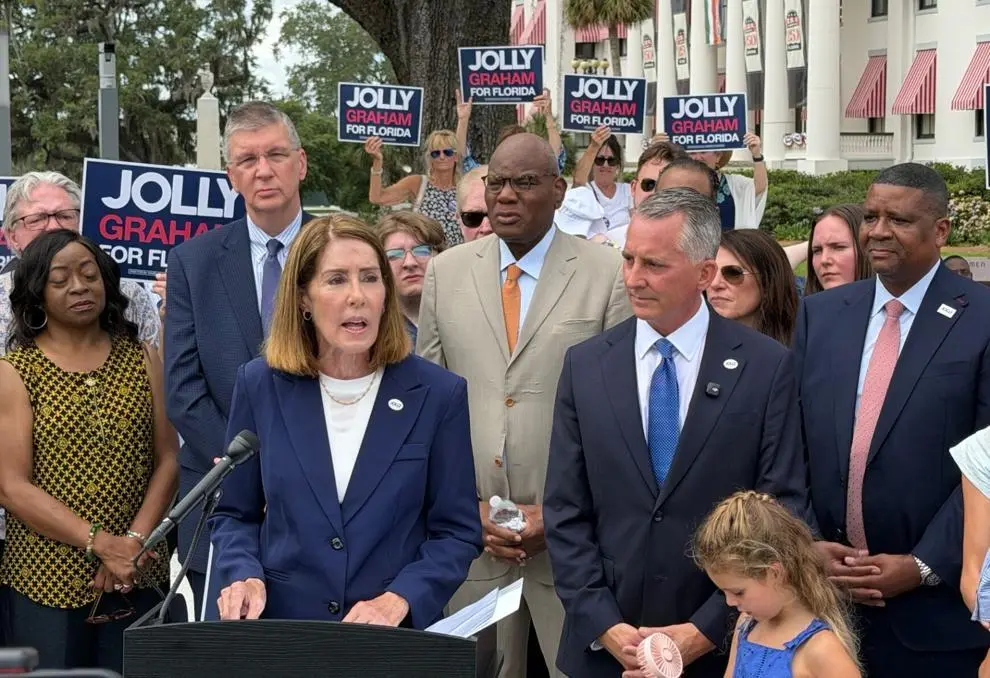
Meanwhile, Democrats have one clear front-runner: former U.S. Rep. David Jolly. Days after his only serious primary challenger, Orange County Mayor Jerry Demings, quit the race to fight recently diagnosed cancer, Jolly chose his running mate: Gwen Graham…
Also a former member of Congress, she ran for governor in 2018, and narrowly lost the Democratic nomination to Andrew Gillum.
Graham knows how important primary elections can be in Florida. A primary, then a runoff catapulted her father, Bob Graham, to the Governor’s Mansion for eight years, followed by 18 years in the United States Senate.
Ever since Gwen Graham lost in 2018, people in political circles have speculated whether she would have beaten Ron DeSantis in November 2018 if she had been the nominee.
Read more Class of 2026: Orange County’s valedictorians & salutatorians
We’ll never know. But we do know this: Gillum, a candidate with broad appeal but obvious flaws, came within four-tenths of a point of becoming the first Black governor in Florida history.
The road to November
As we noted in Sunday’s editorial, surprises often flip the narrative in primary elections. In the Republican primary for governor in 2018, Agriculture Commissioner Adam Putnam looked like an early shoo-in. He was trounced by the little-known DeSantis, who had President Trump’s endorsement.
Perhaps because primaries often are not definitive, voters don’t think they are important. That’s wrong. (period)
In statewide races, for Congress and the state Legislature, they often are nominating contests, winnowing the field and setting the stage for a Republican versus a Democrat in November. In several nonpartisan Orange County races, they will narrow the group of candidates to the top two vote-getters, who will face off in November.
The redrawn congressional map means that more than 400,000 (comma not period) voters now live in a different congressional district, according to local supervisors of elections. Some will be assigned to vote in different precincts.
Everyone so affected must receive a new voter ID card before the primary. When the card arrives, keep it. Don’t throw it out.
In the weeks to come, the Sentinel Editorial Board will interview candidates in many of the key primary races, and we will recommend candidates up and down the ballot, including for school board, county commission, state legislature and circuit and county judge.
We will do the same for the general election cycle in November, when the stakes are even higher. But no matter what anyone says, remember: Primaries matter. Be sure you vote.
The Orlando Sentinel Editorial Board includes Executive Editor Roger Simmons, Opinion Editor Krys Fluker and Viewpoints Editor Jay Reddick. The Sun Sentinel Editorial Board consists of Executive Editor Gretchen Day-Bryant, Editorial Page Editor Steve Bousquet, Deputy Editorial Page Editor Dan Sweeney and editorial writers Pat Beall and Martin Dyckman. Send letters to [email protected].
Read more Season’s 1st tropical storm could form in Gulf, hurricane center says